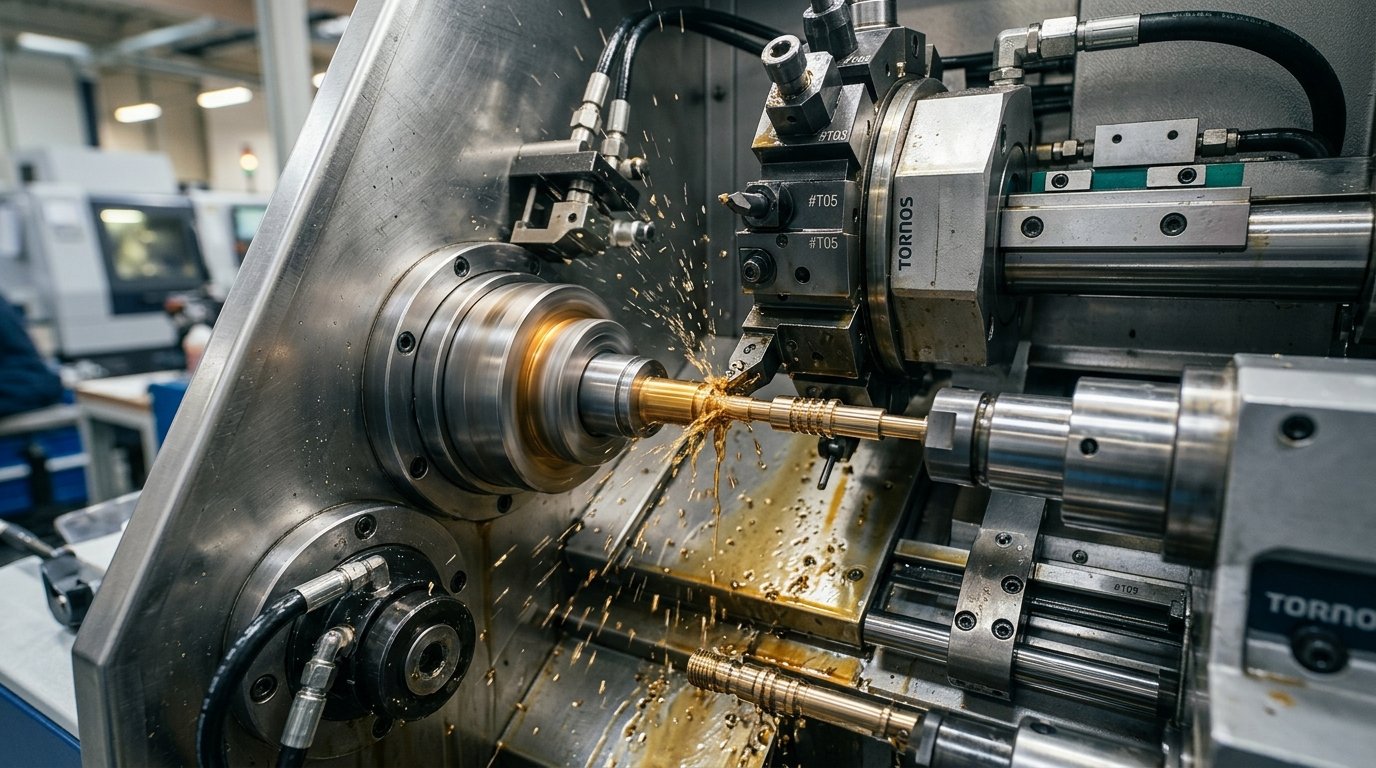
Material Selection in Precision Turned Components
Choosing between Austenitic Stainless Steel (SS304/SS316) and Free-Cutting Brass (CW614N / IS 319 Grade I) is one of the most critical design decisions in component manufacturing. Both alloys exhibit exceptional corrosion resistance, but their cutting mechanics, tool wear rates, and thermal conductivities diverge dramatically.
Chemical & Mechanical Comparison
| Engineering Property | Free-Cutting Brass (CW614N) | Stainless Steel 304 (AISI 304) | Engineering Implication |
|---|---|---|---|
| Machinability Rating | 100% (Industry Reference Standard) | 40% to 45% | Brass enables 3× higher spindle speeds and longer tool life |
| Tensile Strength | 380 – 500 MPa | 515 – 700 MPa | SS304 provides higher yield and shear resistance in heavy loads |
| Work Hardening Tendency | Very Low (Discontinuous short chips) | High (Continuous tough stringy chips) | SS304 requires sharp positive inserts with chip breakers |
| Electrical Conductivity | ~28% IACS | ~2.5% IACS | Brass is the gold standard for electrical switchgear contacts |
When to Choose Brass vs Stainless Steel
- Choose Brass CW614N when: High electrical conductivity, non-sparking properties, complex internal threading, or rapid high-volume cost efficiency is required.
- Choose SS304 when: Harsh acidic or marine chemical resistance, elevated temperature service (>300°C), and high structural strength are mandatory.
Cost Optimization Tip
For electrical switchboards and metering hardware, utilizing precision turned brass with a 3-5 micron nickel or silver flash coating often delivers superior conductivity and corrosion defense at 30% lower machining cycle cost than stainless steel.
